
Mission Gurukulam
The way to Building Universally Competent Leaders.Education is not the amount of information that is put into your brain and runs riot there, undigested, all your life. We must have life-building, man-making, character-making assimilation of ideas. If you have accumulated five ideas and made them your life and character, you have more education than any man who has got by heart a whole library.… If education is identical with information, the libraries are the greatest sages in the world and encyclopedias are the Rishis.”
“We want that education by which character is formed, strength of mind is increased, the intellect is expanded, and by which one can stand on one’s own feet.”
“What is education? Is it book-learning? No. Is it diverse knowledge? Not even that. The training by which the current and expression of will are brought under control and become fruitful is called education.”
“To me the very essence of education is concentration of mind, not the collecting of facts.” –Swamy Vivakananda
Modern education treats learning as a transactional acquisition of fragmented skills, creating an elite workforce that excels in narrow technical domains but lacks cognitive resilience, ethical anchoring, and systemic vision. To counter this, The framework presents the architectural blueprint for a 21st-century Gurukulam engineered to produce universally competent leaders. By synthesizing the five-fold action framework of the Bhagavad Gita with the cognitive sciences of the Smriti Chandrika and the multi-disciplinary mandate of the Sushruta Samhita, this institution bridges timeless Eastern epistemologies with the fast-paced requirements of the global techno sphere.
अधिष्ठानं तथा कर्ता करणं च पृथग्विधम् ।
विविधाश्च पृथक्चेष्टा: दैवंचैवात्र पञ्चमम् ।।
adhiṣṭhānaṃ tathā kartā karaṇaṃ ca pṛthagvidham .
vividhāśca pṛthakceṣṭā: daivaṃcaivātra pañcamam ..
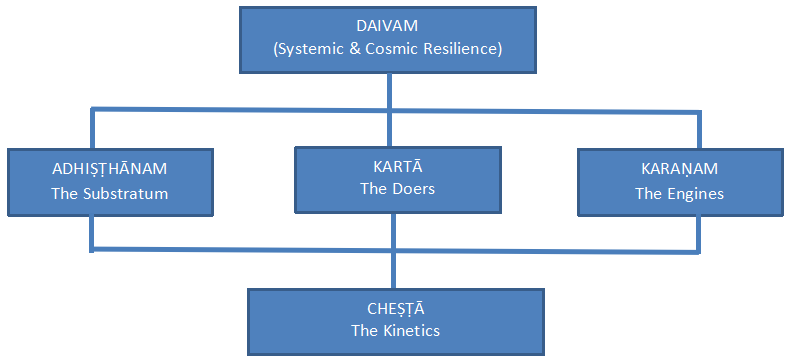
This verse is from the Bhagavad Gita (Chapter 18, Verse 14). It lists the five essential factors required for the accomplishment of any action or task of establishing a Gurukulam.
Pillar 1: Adhiṣṭhānam (Substratum):
The term ‘Adhiṣṭhānam’ shall be understood as Base / Substratum / Seat / Foundation. An unshakeable foundation requires the precise alignment of material execution with transcendental intent. The Gurukulam bifurcates its basic foundational drive / substratum into two distinct layers:
1.1 Uddēśya (Tangible Purpose):
This represents the tangible, operational goals required to sustain the institution day-to-day.
- Financial Sustainability: Generating enough revenue or donations to provide comfortable living quarters, nutritious food, and fair compensation for the Acharyas.
- Institutional Reputation: Gaining legal accreditation, building a respected brand, and achieving high student enrollment.
- Infrastructure Growth: Expanding the physical campus, building libraries, and upgrading facilities using institutional funds.
1.2 Dhyēya (Generational Mission):
The non-negotiable spiritual and cultural anchor focused on character awakening, traditional science revival, and civilizational continuity. This is the selfless, higher cosmic purpose that outlives the founders and justifies the Gurukulam’s existence to society.
- Cultural Preservation: Reviving dying traditional sciences, Vedic knowledge systems, and classical arts.
- Character Awakening: Transforming students into self-aware, ethical, and emotionally resilient leaders rather than just degree-holders.
- Universal Well-being: Serving the larger global community (Vasudhaiva Kutumbakam) through free knowledge dissemination and community service.
True Adhishtanam harmonizes the two using practical success to fuel the higher mission. An institution fails if it focuses only on one. If you only focus on Uddeshya, the Gurukulam risks becoming a commercial, transactional business. If you only focus on Dhyeya without securing the physical Uddeshya, the institution will collapse due to financial and operational strain.
1.3 Adarsha /Ideological Adhishtanam (The Core Values):
The unshakeable philosophy and vision upon which the entire institution is anchored.
- Sanatana Framework: The foundational vision statement rooted in ancient wisdom (e.g., “Saa Vidyaa Yaa Vimuktaye”—Knowledge is that which liberates).
- Lineage & Tradition: The Parampara(lineage of knowledge) or specific school of thought your Gurukulam chooses to preserve and pass down.
- The Living Intent: The foundational intent of the founders, which must be focused on character building (Charitra Nirman) rather than commercial education.
1.4 Sthana (Physical) Adhishtanam (The Eco-Space)
The physical environment must act as a silent teacher, reflecting ancient spatial wisdom aligned with nature.
- Geographic Vibe: A serene location away from urban chaos, ideally near elements of nature (forests, hills, or rivers) to foster contemplation.
- Vastu & Architecture: Eco-friendly, sustainable structures made of natural materials (mud, stone, wood, bamboo) rather than cold, corporate concrete.
- Sacred Anchors: The inclusion of a central Yajnashala(fire altar space), a Goshala (cow shelter), and dedicated meditation zones (Dhyana Kendras) that form the physical core.
1.5 Samsthagata (Institutional) Adhishtanam (The Regulatory Frame)
The unseen organizational structures that give the institution legal, operational, and financial stability.
- Legal Base: The trust, society, or legal framework that holds the land and assets securely for future generations.
- Daily Rhythm (Dinacharya): The foundational daily timetable (waking up at Brahma Muhurta, morning prayers) that dictates the energy of the campus.
- Financial Ethos: An economic foundation built on Danashala (philanthropy) or sustainable community funding rather than transactional, high-fee business models.
Pillar 2: Kartā (The Sattvik Leadership & Faculty)
The human catalysts of the Gurukulam operate on the principles of Sattvik Action—free from institutional ego, grounded in personal integrity, and fueled by unwavering dynamic enthusiasm (Utsāha).
2.1 The Acharyas (The Spiritual & Academic Doers)
The Acharyas are the living embodiments of the Gurukulam’s ethos.
- Living the Knowledge: They must practice what they preach (Acharat iti Acharya). Their personal lifestyle must mirror the values taught in the classroom.
- Parental Bond: Unlike modern commercial teachers, a Sattvik Karta adopts a parental attitude toward students, focusing on holistic character development rather than just finishing a syllabus.
2.2 The Founders and Management (The Visionary Doers)
The administrative leaders run the operational machinery.
- Egoless Execution: The Gita states that a true Karta is free from ego (mukta-sanga anaham-vadi). The founders must view themselves as custodians of the tradition, not owners of the institution.
- Resilience (Dhriti-Utsaha): Establishing a Gurukulam will bring bureaucratic, financial, and societal challenges. The leadership must possess unwavering fortitude (dhriti) and dynamic enthusiasm (utsaha) to cross these hurdles without losing heart.
2.3 The Students (The Learning Doers)
Students are not passive consumers; they are active participants in the action.
- Self-Discipline: They must transition into the role of a Jigyasu (an earnest seeker of truth) who actively engages in Seva (service) and Svadhyaya (self-study).
- The Pupil be transformed from a passive consumer of information into a Jijñāsu—an active, self-disciplined partner in the preservation and execution of truth.
Pillar 3: Karaṇam (The Cognitive Engines)
In the context of your Gurukulam, the third factor—Karanam (करणम्)—represents the instruments, tools, and methodologies used to deliver knowledge and manage the institution. The verse specifies that Karanam is Pṛthak-vidham (of various distinct kinds). For a successful Gurukulam, this means seamlessly blending ancient pedagogical instruments with modern functional tools.
3.1. Pedagogical Instruments (Tools for Learning)
These are the methods used to transform raw information into realized wisdom (Vijnana).
- The Oral Tradition (Shravana, Manana, Nididhyasana): The primary instrument of listening attentively, reflecting deeply, and meditating upon the truth to internalize it.
- Debate and Discussion (Vada-Shastra): Using structured debate as a sharp intellectual tool to refine understanding and clear doubts.
- Multisensory Learning: Utilizing practical instruments like Yajna(rituals), Seva (community work), arts, and nature walks to teach complex cosmic and scientific concepts through experience.
3.2. Curricular Instruments (The Content)
The subjects and frameworks that form the core material of instruction.
- The Para and Apara Vidya Blend: Balancing Para Vidya (spiritual knowledge, Upanishads, Darshanas) with Apara Vidya (material sciences, mathematics, astronomy, economics, and warfare/defense).
- The Vedangas: Using linguistics (Vyakarana), phonetics (Shiksha), metrics (Chhandas), and astronomy (Jyotisha) as foundational tools to decode deeper texts.
3.3. Modern Technological Instruments (Tools for Management)
To survive and scale in the 21st century, the Gurukulam must adopt contemporary tools without compromising its soul.
- Digital Infrastructure: Utilizing modern learning management systems, high-quality audio-visual recording setups (to preserve rare recitations), and global communication tools to reach seekers worldwide.
- Somatic Tools: Providing sports equipment, martial arts gear (like Kalaripayattu or Dhanurveda tools), and organic farming implements to ensure complete physical development.
Pillar 4: Cheṣṭā (The Kinetic Multi-Disciplinary Effort)
To fulfil the warning of the Sushruta Samhita—that a student of a single discipline can never grasp absolute truth—the daily efforts (Cheṣṭā) of the pupil are structured as a rigorous, T-shaped cross-pollination protocol:
- Depth & Breadth: Traditional sciences (Sanskrit linguistics, Vedic philosophy, Arthashastra) are forced to collide daily with global contemporary systems (Artificial Intelligence, macroeconomics, quantum mechanics).
एकं शास्त्रमधीयानो न विद्याच्छास्त्रनिश्चयम्।
तस्माद्बहुश्रुतः शास्त्रं विजानीयाच्चिकित्सकः।।
ekaṃ śāstramadhīyāno na vidyācchāstraniścayam.
tasmādbahuśrutaḥ śāstraṃ vijānīyāccikitsakaḥ.
Sushruta’s warning—“Ekāṁ śāstramadhīyānō na vidyācchāstraniścayam” (One who studies only a single discipline can never truly master it)—serves as the foundational rule for how your pupils must gather information.
Here is how you can practically structure this multi-disciplinary “Intake Phase” within the daily efforts of your Gurukulam to build universal competence:
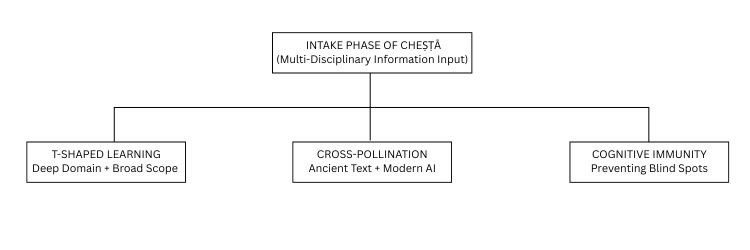
- The Effort of T-Shaped Learning (Bahuśrutaḥ)
To ensure pupils become Bahuśrutaḥ (widely heard/read), the intake routine must mandate dual-track absorption.
- The Vertical Depth:A student chooses one core mastery (e.g., Data Science, Ayurveda, or Macroeconomics).
- The Horizontal Breadth:The Cheṣṭā (effort) requires them to spend dedicated hours absorbing adjacent fields. A data scientist must study Sanskrit linguistics to understand syntax; an Ayurveda student must study modern biochemistry. They cannot have one without the other.
- Radical Cross-Pollination of Knowledge
Sushruta recognized that fields do not exist in isolation. The intake phase must deliberately force diverse subjects to collide.
- Synthesized Reading Tracks: Design the daily curriculum so that reading an ancient treatise on governance (Arthashastra) is immediately paired with a modern case study on global supply chain logistics or game theory.
- The “Physician” Mindset: Just as a physician (Cikitsakaḥ) must know anatomy, chemistry, astrology, and psychology to treat a single body, a modern consultant or leader must understand history, technology, and human behavior to solve a single corporate or social problem.
- Deliberate Elimination of Cognitive Blind Spots (Śāstraniścayam)
Studying only one subject creates an echo chamber. The intake Cheṣṭā must actively shatter bias so students can reach the absolute core conclusion (Śāstraniścayam) of a problem.
- Deconstructive Intake:When studying a global issue (like climate change or economic inflation), the student’s intake effort must involve reading conflicting viewpoints—traditional ecological practices versus aggressive industrial economics.
- Universal Competency:This training ensures that when graduate steps into the UN, a tech boardroom, or a research lab, they do not look at problems through a single, narrow pipeline. They possess the intellectual agility to synthesize the whole picture.
Pillar 5: Daivam (The Macro-Systemic Resilience)
The ultimate crown of a universal leader is the recognition of Daivam—the unseen variables, systemic shifts, and cosmic rhythms that govern the world.
- Alignment over Friction: The Gurukulam positions itself as the timely antidote to the global crisis of attention, ethics, and meaning.
- Antifragile Consciousness: By training students to dedicate 100% of their efforts to execution while detaching emotionally from the final fruits, the Gurukulam creates leaders who are entirely immune to anxiety, arrogance, or the fear of failure. They do not break under systemic crises; they recalculate and lead.
The Manifesto Declaration
We reject the assembly-line model of education that turns out hyper-specialized but spiritually unanchored professionals. We assert that true global competence demands an integrated approach: a sharp analytical mind driven by ancient ethical anchors. This Gurukulam is not a retreat into the past; it is a leap into the future, engineering the next generation of global leaders who can master technology, command industries, and preserve the soul of humanity.